The Beginnings and Early Life
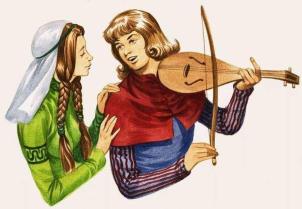 Francis was not of noble birth, but his father, a cloth merchant, was rich. So Francis did associate with the sons of nobles and, it is said, partied with them.It was also a time of chivalry, and Francis had heard stories of knights rescuing ladies fair. This environment influenced Francis to don the armor of a knight and go off to battle, which made his father proud.
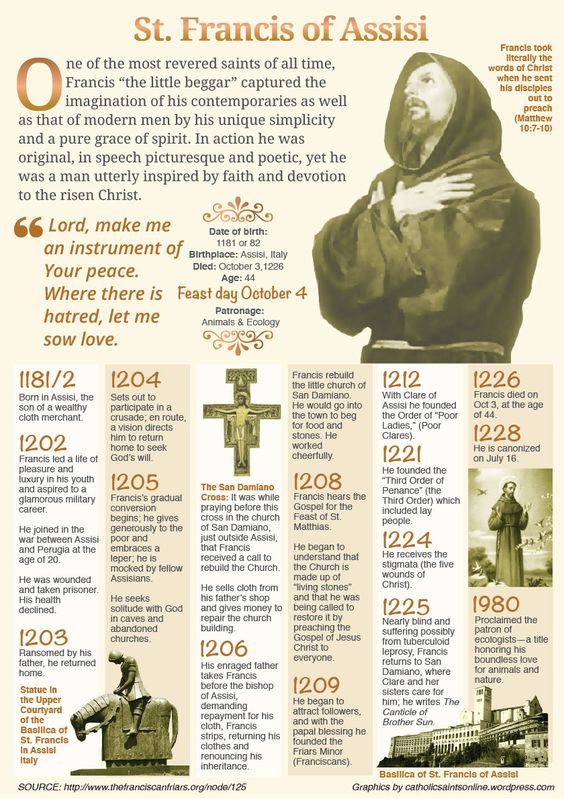
 At that time in history, there were city states overseen by nobles who had allegiance to the emperor or to the Holy See. In 1160, “Frederick Barbarossa declared Assisi a free city under the protection of the empire…However, the presence of a handful of imperial soldiers did not impede the local political situation’s evolution towards autonomy…From 1162 to 1184 there was continuous growth and uprising of autonomous city-states, referred to as communes, throughout …which the imperial authority was too weak and too far away to prevent.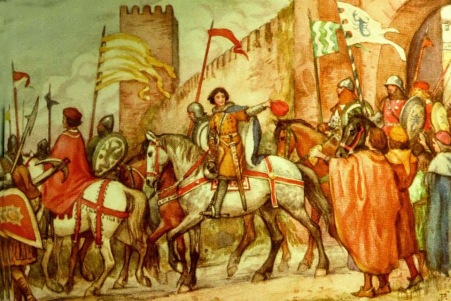 “…The main reason, however that Assisi was ‘imperial’ was that its traditional rival, Perugia, was ‘papal.’” “The period from 1174 to 1210 marks the last and definitive collapse of the feudal structure in Assisi. In 1174 the city was destroyed by imperial forces. In 1198, when Francis was sixteen years old, Assisi was freed once and for all from imperial domination…” “In the period immediately preceding the birth of Francis, and even more during the years of his youth, a deep change took place in the social classes, even in Assisi…There were now two powers struggling, two groups whose pride was hurt. The vassals envied the wealth of the ‘nouveaux-riches,’ while the latter wanted to imitate their neighbors in high positions of honor, arms, and even knighthood. “Another element played an important part in the psychological development and orientation of the young Francis, the knightly element or ‘chivalry’ remained within the saint. “It was November of 1202, and Francis was twenty years old.The Assisians, convinced they were able to win [the war against Perugia] prepared with all the means at their disposal and with great enthusiasm.
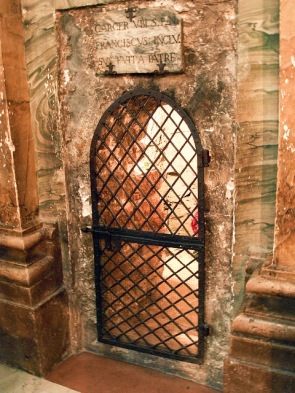
Francis, young, rather rich, and a great belief in the cause of the weak against the mighty, was among the most enthusiastic of all. The skirmish took place at Collestrada, where from dawn to dusk the battle raged, waned, and gained momentum. The Perugians, stronger in the long run, won. Francis, wounded, found himself among the prisoners.”
“In those days a prison was really a prison –for the most part caves dug in the basement of a large municipal palace. They were dark and damp, the prisoners had little more than bread and water. “For Francis this was his first encounter with a reality far different from his youthful dreams of pleasure and glory, and the beginning of a long and profound crisis. If it had not been for the defeat at Collestrada, perhaps we would never have had a Francis of Assisi. “Francis could keenly feel that something had betrayed him. Money, more and more money. Yet, what advantages had it given him? Beautiful clothes, the latest styles, friendship, affirmation in leading the youth of Assisi, organizing dinners and entertainment. Yet, what had he gained? Where were his friends now?”
Francis’ Conversion Process
Francis’ “Master or Servant” Dream in Spoleto
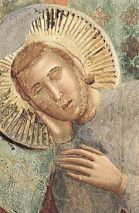 After Francis’ return home from prison in Perugia, he still embraced his visions of winning glory by returning to the battlefield. Count Walter of Brienne, a “folk” hero in his time, was recruiting soldiers for a campaign in Sicily. On the way, Francis fell ill at the town of Spoleto. There he had a vision: a voice demanded of Francis where he intended to go: “’Who do you think can best reward you, the Master or the servant?’ Francis answered: ‘The Master.’ The voice questioned further, ‘Then why do you leave the Master for the servant, the rich Lord for the poor man?’ Francis replied in the same words of St. Paul on the road to Damascus: ‘Lord, what do you want me to do?’ He received the same answer that Saul did: ‘Return to your own place, and you will be told what to do.’ (Acts 9:6-7).”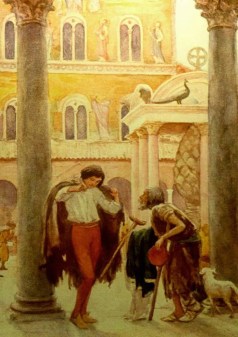
Pilgrimage to Rome –
Changing Clothes with a Beggar
Embracing the Leper 
San Damiano – Giving Money to Priest
Scene Before Mayor and Bishop – Rejecting Money and Clothing
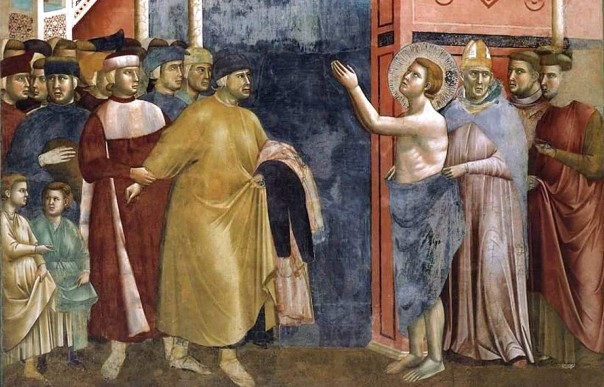 the bishop before asking Francis to give back the money to his father, advised him to think about the fact that this was the condition necessary for him to become a conversus: ‘If you really want to consecrate yourself to the Lord, you must give back the money you have…Francis replied…‘Since I have decided to dedicate myself to the service of the Lord…I shall give him back not only money…but also the clothes.’ “Francis left the scene of the renunciation, officially recognized as a penitent by the bishop of Assisi and, as a penitent, he will permanently reside at San Damiano.”
Francis is Called to Rebuild San Damiano
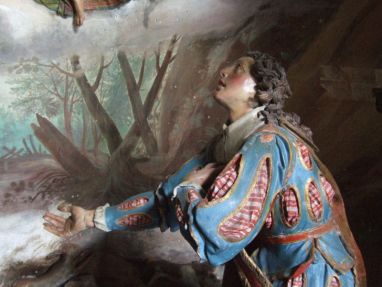 “In eager anticipation, Francis looked up into the serene face of the crucified Lord, and prayed this prayer: ‘Most High, glorious God,’ he prayed, ‘cast your light into the darkness of my heart. Give me, Lord, right faith, firm hope, perfect charity, and profound humility, with wisdom and perception, so that I may carry out what is truly Your holy will. Amen.’ Ever more quietly he repeated the prayer, lost in devotion and wonder before the image of his crucified Lord. “Then, in the quietness, Francis heard Jesus speaking to him from the Cross: ‘Go, Francis, and repair my house, which as you can see, is falling into ruin.’” So, in obedience, Francis proceeded to follow Jesus’ word, literally.
Francis’ Approval by Innocent III and Pope Innocent’s Dream
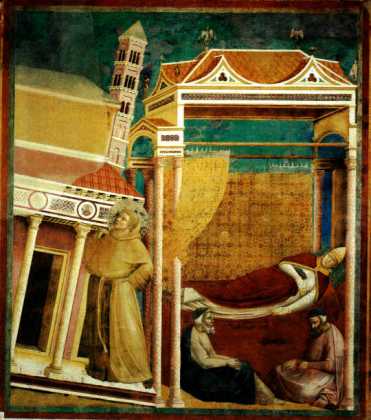 this, Bishop Guido was easily able to guide Francis among the rocks which had destroyed many of his predecessors in the penitential movement. A good part of the success of the young man from Assisi can probably be attributed to the wise advice of the bishop of Assisi. “When, only two years later, in the spring of 1210 [many historians believe it was 1209], Francis and his companions went to the Lateran, asking the pope for approval of their ‘fraternity of itinerant preachers,’ based on poverty, but also on the two pillars of a ‘complete adherence to the Church’ and ‘obedience to the hierarchy,’ Innocent III, assured of their ‘fidelity’ either directly or through Cardinal John of St. Paul, had little or no hesitation to give them permission to ‘preach penance to all.’” “At his first meeting with Francis, Innocent III was perplexed at receiving the request to approve Francis’ way of life. In Vita Seconda … Celano states that the following night the pope dreamed that the Lateran basilica was beginning to fall when a tiny, scraggly religious held it up with his shoulder so that it did not fall. He recognized in that ‘religious’ the man whom he had sent away the previous evening and, as a result of this dream, he immediately ‘granted the request’”
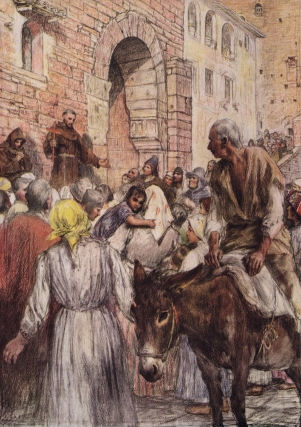 Francis Preached the Kingdom of God
The Story Continues . . .


 The Lesser Brothers (the friars minor)
St. Clare and her sisters (the poor Clares)
Brothers and Sisters of Penance (the secular Franciscans)
History of Our Rule of Life
The Nativity Creche-Christmas Manger
The Peace Prayer of Saint Francis
The Canticle of the Creatures
The Blessing of Saint Francis
Prayer Before the (San Damiano) Crucifix
The Praises of God
The Meditation Prayer of St. Francis of Assisi
~ Material for this page from “A Brief History of the Secular Franciscan Order and its Rules” by William Wicks, OFS. Please consult this publication for complete citations and references (left out of this text for brevity).
 IL POVERELLO FRATERNITY