Penitential Movement – Pre-Francis
For the first five or six centuries of our church history, members were required to avoid serious sin. The penalty for serious sin was excommunication from the community.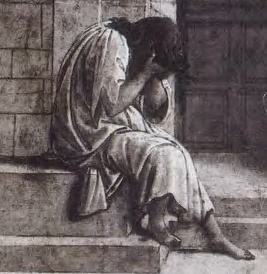 However, one was allowed to rejoin the community on a “second chance” very restrictive basis. This reconciliation required severe penance such as lifelong fasting, abstinence from attending church functions and from reception of the Eucharist, external displays of self degradation: sack-cloths, and the like. In time, these strict rules became canon law, with the bishop authorizing and overseeing reconciliation.
Changes in restorative penance in Europe and Asia were influenced by Celtic monks who practiced “private” penance: the priest would assign a penance at his discretion, the severity in accordance with the gravity of the sin. About the same time there were those who volunteered to become penitents, with the same obligations of the canonical penitents, in order to become holy – to live like Jesus and the Apostles.
These volunteers were the precursor of the penitential movement, as embraced by St. Francis of Assisi. “With the growth of private penance [given by a confessor], there was a clear distinction between the public penitents and the voluntary penitents. These first made expiation for their sins in the manner prescribed for days, months, and years as established by the Penitentials; the second group, the voluntary penitents, remained in Ordo Poenitentium for the rest of their lives. These are the two aspects of the Ordo Poenitentium through the middle ages.
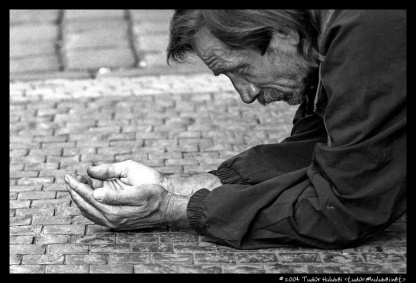 publicly decided to abandon the way of life which he had formerly led and to devote himself to God in one of the various forms of penitential life, reveals that the ultimate goal of such a choice was to make God one’s point of reference and the very reason for life; this end was obviously very spiritual. This interior decision, however, was also externally visible by means of the penitential habit.”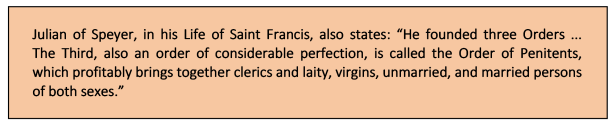
It Was the Time of the Preacher
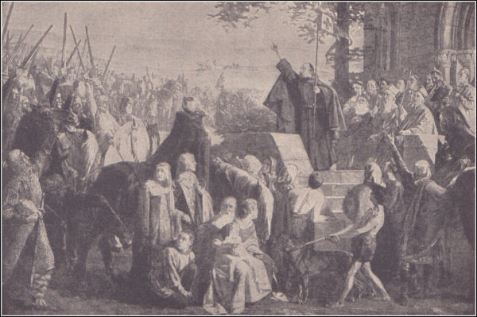 were the essential components of a truly apostolic life. “It is most important to note that the itinerate preachers – who began their wandering at the beginning of the twelfth century, lived in poverty, preached as the apostles did, and gathered groups of followers – found themselves immediately faced with the problem of how to insert themselves and their followers into the structure of the Church, which did not envision groups whose members while aiming at the perfect evangelical life, did not at the same time live according to a rule and in a monastery. Thus there was no place for the groups who roamed about the countryside.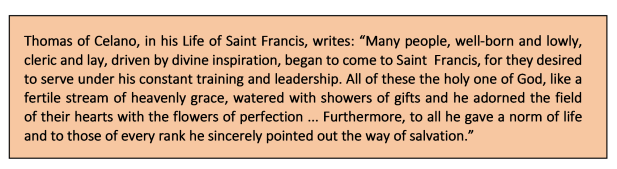
It was into this time and void that Francis appeared.
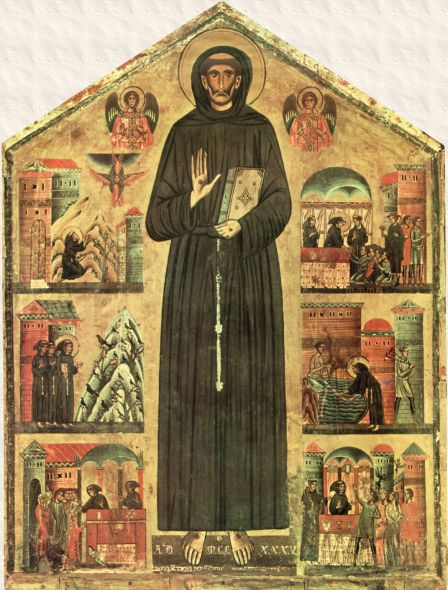 For Francis, to convert oneself interiorly is to recognize the universal paternity of God over all creation and to recognize the universal fraternity of humankind with all creation. Initially, Francis and his companions were known as “the penitents of Assisi”. Almost 800 years ago, Francis exactly anticipated, so to speak, the contents of the II Vatican Council by recognizing the relevance of the ‘Theology of the Laity’ in his day. In drawing from the evangelical purity of the origins (Christ and the apostles), Francis restored the Church giving full citizenship to all components of the human family and the “Church” (clerics, men and women, religious and laity) for assuming responsibility for spreading the Gospel of Christ. The Crucifix of San Damiano entrusted Francis with a mission: “Francis go, repair my Church, which, as you see, is all in ruins.” In order to pursue the mission Christ inspired him to give life to a triple militia /host (FF1031). All three Orders generated by Francis, are in fact heirs of the mission and of the charism to accomplish it.
 IL POVERELLO FRATERNITY